
In-House Localization vs LSP: A Fair Comparison
In-house localization vs LSP: compare cost, scale, language coverage, tools and quality control, and see when a hybrid model works best.
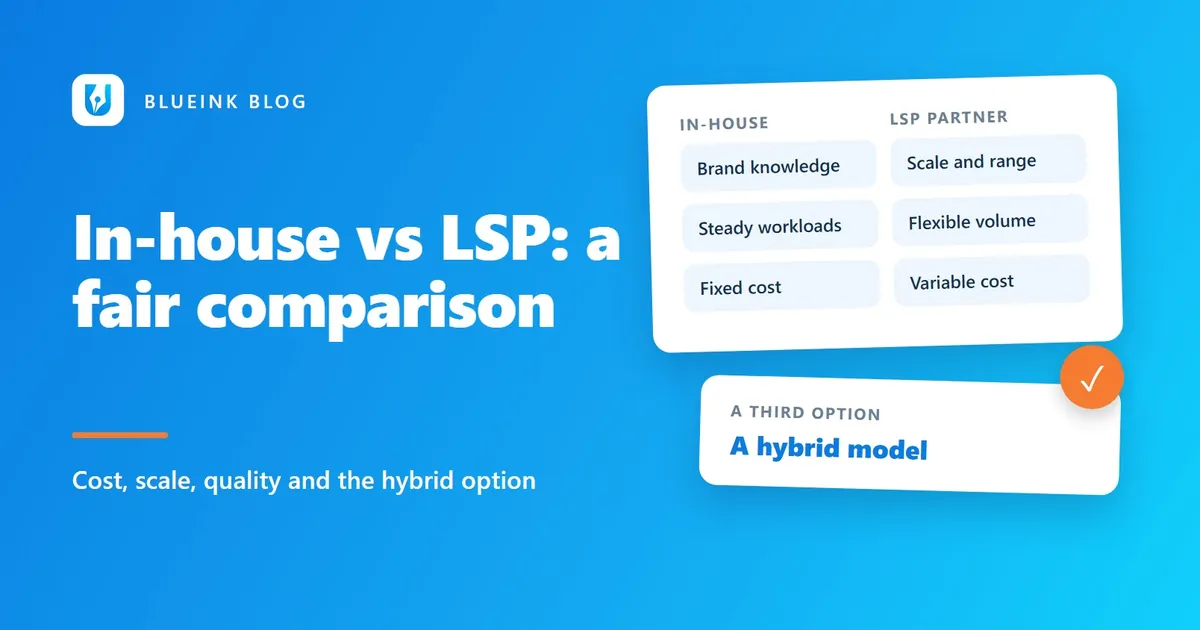
A company is about to enter three new markets. The question comes up in the planning meeting: do we hire a localization team, or work with a partner? Both answers can be right. Both can also go wrong.
Blueink is a language service provider, so we have a view. This in-house localization vs LSP comparison tries to set that view aside and gives you a fair way to weigh the options. It covers cost, scale, language coverage, tools and quality control, and it shows where a hybrid model works best.
Key Takeaways
- An in-house team knows your brand and products best. A partner brings flexibility, range and established processes.
- The deciding factors are usually volume, the mix of languages, how steady your workload is and how much management you can take on.
- A hybrid can suit teams that want an in-house owner for brand and terminology and a partner for volume and range.
- Whatever you choose, measure quality the same way, and agree who owns the glossary.
What are the two models?
An in-house localization team is a group of employees who manage and sometimes do the translation work for your company. They sit inside your organization and work with your product, marketing and legal teams.
A language service provider, or LSP, is an outside company that provides translation and localization services. It may offer translators, reviewers, project managers, testers and technology. You work with it by project or under a longer agreement.
Neither model is better in every case. The right one depends on what you need, how much of it and how often.
How do cost structures differ?
In-house costs are mostly fixed, and partner costs are mostly variable. That difference matters more than any single price.
With an in-house team, you pay salaries, benefits, training, tools and management whether the workload is heavy or light. That can be efficient when work is steady and predictable. It is expensive when work is uneven.
With a partner, you usually pay for what you send, by volume, by project or under an agreed plan. Costs rise and fall with demand. You also avoid recruiting and tool costs, although a partner's price includes its own overhead.
Count the hidden items on both sides. In-house includes hiring time, backup for absences and tool licenses. A partner includes the time you spend briefing, reviewing and managing the relationship.
How do scale and speed compare?
A partner usually scales faster, and an in-house team usually responds faster on small, familiar tasks. Your workload shape decides which matters more.
Peaks are the test. A product launch, a campaign or a year-end report can multiply your workload for a few weeks. An in-house team can be stretched thin. A partner can add people for the peak and release them after.
For small daily requests, such as a quick fix to a button label, a colleague down the hall is hard to beat. They know the context and can answer in minutes.
What about language coverage?
An in-house team covers the languages its members speak, and every new language usually means a new hire or a new contractor. A partner typically works with a network of linguists across many languages, so adding one is a matter of scoping, not recruiting.
This matters if your plans change. Entering one market a year is manageable in-house. Entering several markets at once, or adding less common languages, is where a partner's range helps.
Depth matters as well. A single in-house linguist in a language may lack backup, or a second pair of eyes. Ask who covers when that person is away.
How do tools and technology compare?
Localization uses specialized software. This includes systems that manage content flow, store approved translations for reuse and check terms. Two of these tools are the glossary, a list of approved terms, and the translation memory, a store of approved translations that can be reused. Our guide on keeping financial terminology consistent explains both.
In-house, you choose, buy, set up and maintain the tools. That gives you control and fits your own workflow, but it takes expertise and budget. A partner usually has tools in place. It can work with the file formats your teams already use, such as those for software localization and website localization.
Be careful about lock-in either way. Make sure your glossary and approved translations stay yours, in a format you can take with you.
How does quality control differ?
Both models can deliver excellent quality, and both can fail without a clear process. The question is who checks, how, and against what standard.
An in-house team has the advantage of context. They know your products, your customers and your preferred terms. They can ask a colleague and get an answer. The risk is blind spots. Teams that review their own work, or that rarely see outside work, may miss habits that readers notice.
Many partners bring established review steps and experience across clients. Ask to see theirs. The risk is distance. Without good briefing and a shared glossary, a partner can miss your brand's voice.
The remedy for both is measurement. A scoring framework such as MQM (Multidimensional Quality Metrics) sorts errors by type and severity. That lets you compare results over time, whoever produced the work. Our plain-English guide to MQM explains how it works.
In-house localization vs LSP: how do the options compare side by side?
| Factor | In-house team | LSP partner |
|---|---|---|
| Cost structure | Mostly fixed | Mostly variable |
| Handling peaks | Harder | Easier |
| Brand and product knowledge | Strong | Depends on briefing |
| Adding languages | Hire or contract | Scope with the partner |
| Tools | You buy and maintain | Usually provided |
| Quality control | You design it | Provided, to be agreed with you |
| Speed on small tasks | Fast | Depends on the agreement |
| Management effort | You manage the team | You manage the relationship |
Use the table as a conversation starter. Each row can tilt either way depending on your situation.
When does an in-house team fit best?
An in-house team fits when your workload is steady, your languages are few and your content needs deep, constant context. Picture a team that ships weekly app updates in Hindi and Tamil. This is a hypothetical case. The work is steady and the context changes daily, so an embedded linguist who knows the app can answer questions in minutes.
It also fits when you want direct control, and when localization is central to your product. Confidentiality needs careful handling in either model, with agreed terms, access controls and a defined process for handling files. If you want to build long-term expertise inside your company, hiring makes sense.
When does an LSP partner fit best?
A partner fits when your workload swings, your languages are many or changing, or you lack the time to build a team. It also suits companies that are new to localization and want established processes from the start.
Partners are useful for one-off projects as well. A single document translation project, such as a set of manuals, rarely justifies a new hire.
When does a hybrid model work best?
A hybrid works well when you want control of what makes your brand yours and flexibility for everything else.
A common split looks like this:
- In-house: owns the glossary, the style guide, the brand voice and final approval. They brief the partner and review what comes back.
- Partner: handles volume, peaks, additional languages, specialist content and testing.
For the split to work, agree on roles in writing. Decide who owns the glossary, who answers questions from translators and how fast. Share feedback in both directions so quality improves with each round. Linguistic testing, such as our linguistic and localization testing, can give a second view of the results, separate from the translation team.
If you use AI tools as part of the workflow, decide together where they are allowed. Our framework for human translation vs AI translation can help you set that line.
What questions should you ask before you decide?
Answer these within your team first. They usually point to the right model.
- How much content do you localize, and how steady is it? Steady work favors in-house. Uneven work favors a partner.
- How many languages do you need now and in two years? More languages tilt toward a partner.
- How specialized is your content? Regulated or technical content needs subject experts in either model.
- Who would manage the work? A team needs a manager. A partner needs a relationship owner.
- How will you measure quality? Pick a method before you start.
- What happens if a key person leaves? Look for backup in both cases.
Frequently Asked Questions
What is an LSP in localization?
An LSP, or language service provider, is a company that offers translation, localization and related services such as testing, subtitling and transcription. It supplies linguists, project management and often technology.
Is in-house localization cheaper than using an LSP?
It depends on your volume. In-house costs are mostly fixed, so they pay off when work is steady and high. Partner costs are mostly variable, so they suit uneven or growing workloads. Compare the full costs of each, including management time.
What is a hybrid localization model?
A hybrid model combines an in-house owner with an LSP partner. The in-house team keeps the brand voice, glossary and approvals. The partner handles volume, peaks and extra languages. Clear roles make it work.
How do I compare quality between in-house and LSP work?
Use the same measure for both, such as a scoring framework like MQM that classifies errors by type and severity. Review samples regularly, and track results over time to see patterns.
What should you do next?
Write down your volume, your languages today and in two years, and your quality method. Then test the options on one real project, with a small pilot for the partner or the team. Blueink offers document translation and related services, and works with in-house teams as well as on its own, with quality checked in-house at Blueink. To talk through your setup, write to projects@blueinki.com.
This is general information.
Need help with software localization?
Tell us about your project and we will send a free, no-obligation quote.
More from the blog

Why Use a Certified Translator for Legal Documents?
A certified translator for legal documents gives you precise wording, a signed certificate and a named person who stands behind the work.
Certified Translation in India: When You Need It and What to Ask For
Visa, university and court applications often ask for a certified translation. Here is what that means and how to order one.
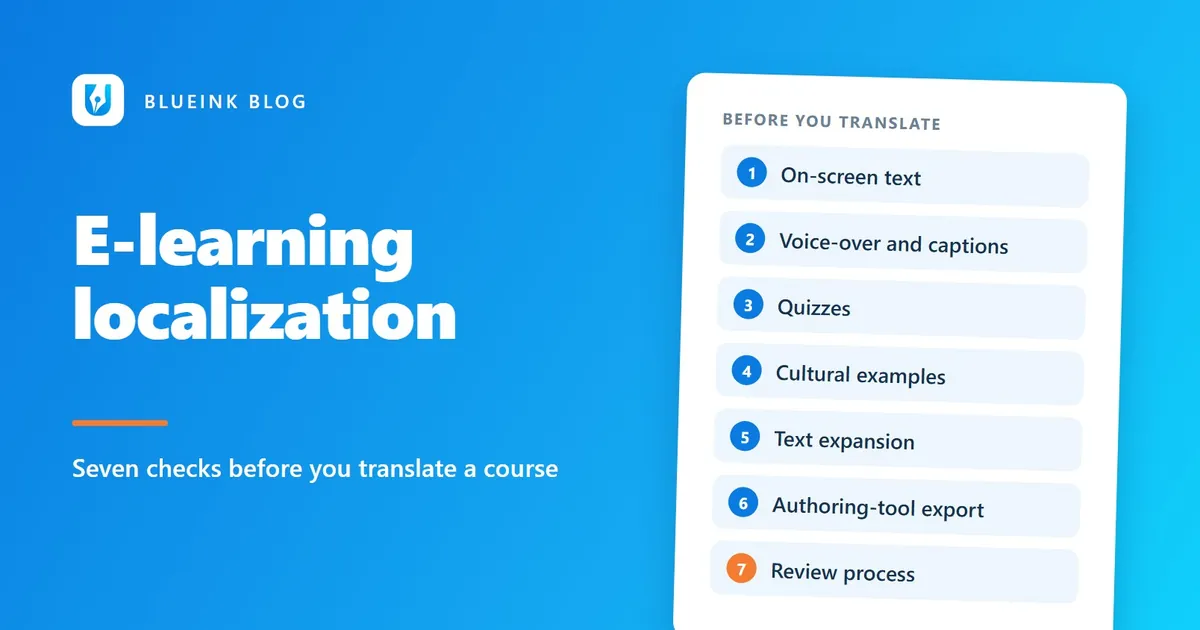
E-Learning Localization: Check These Before You Translate
E-learning localization goes wrong when a course is sent for translation too early. Check these seven things first to save time and rework.