
Financial Translation Services: Keep Terms Consistent
Financial translation services work best with a glossary, translation memory and style guide. Learn how to keep terms consistent across documents.
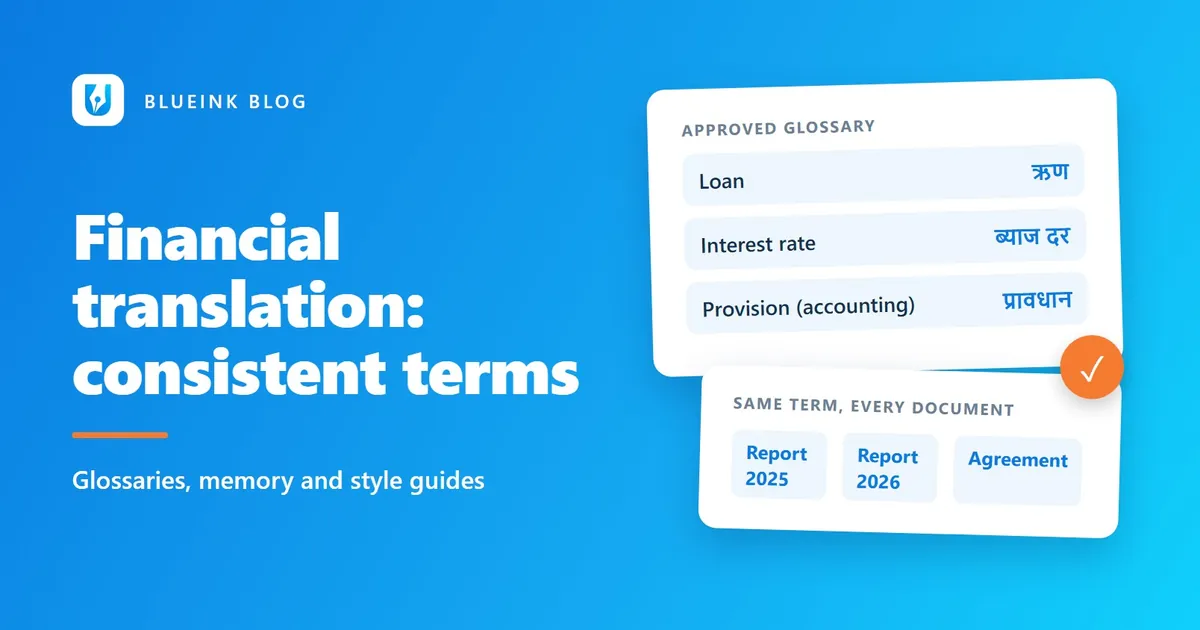
Imagine an annual report that calls a loan "ऋण" (rin) on page 12. By page 40, the same loan is "कर्ज़" (karz). Both words are correct Hindi, and both mean loan or debt. To a reader, though, two words suggest two different products. In a financial document, that doubt is costly.
Finance runs on precise terms, and those terms live for years. Reports, agreements and customer notices are reused, updated and compared against each other. This guide shows how financial translation services keep terminology consistent across all of them.
Key Takeaways
- In finance, one term should mean one thing, in every document and every year.
- Build three tools before translation starts: a glossary, a translation memory and a style guide.
- Have your finance or compliance team approve key terms and any wording set by a regulator.
- Review for consistency, not only for correctness, and update your tools as terms change.
Why does terminology matter so much in finance?
Financial terms have exact meanings, and readers act on them. A customer reads a loan agreement and decides whether to sign. An investor reads a report and decides whether to buy. If the same idea appears under two names, or two ideas under one name, they may reach the wrong conclusion.
Some words also change meaning inside finance. "Provision" in everyday English means a supply or an arrangement. In accounting, it means an amount set aside for a likely cost. A translator who treats it as the everyday word will mislead the reader.
Defined terms add another layer. Agreements often capitalize words such as "Borrower" or "Effective Date" and define them once. That definition must be translated once and used the same way throughout.
Financial translation services cover documents such as annual reports, prospectuses, financial agreements and regulatory documents, and all of them depend on consistent terms.
What three tools do financial translation services use to keep terms consistent?
You need a glossary, a translation memory and a style guide. Each does a different job, and together they keep documents aligned over time.
| Tool | What it is | What it controls |
|---|---|---|
| Glossary | A list of key terms with the approved translation of each | Which word is used for each concept |
| Translation memory | A store of sentences that were translated and approved before | How repeated or similar sentences are reused |
| Style guide | Rules for tone, formats and writing choices | How the text reads and how numbers and dates appear |
A glossary is also called a termbase. A translation memory is software that remembers approved sentences and suggests them when the same sentence appears again. Neither replaces a skilled translator. They give the translator a reliable starting point.
How do you build a useful financial glossary?
Start with the terms your readers meet most. Then add the ones that cause trouble. A useful glossary entry has more than two columns.
For each term, record:
- The source term and a short definition.
- The approved translation in each language.
- Terms to avoid, such as a colloquial word you do not want used.
- Notes, such as "use only in customer notices" or "do not translate the product name".
Here is an illustrative entry set, to be confirmed by a native reviewer.
| Source term | Approved Hindi | Avoid | Note |
|---|---|---|---|
| Loan | ऋण (rin) | कर्ज़ (karz) | Use in formal documents |
| Provision (accounting) | प्रावधान (pravadhan) | None | An amount set aside for a likely cost |
Return to the loan example. Your glossary might say that "ऋण" (rin) is the approved word for formal documents and that "कर्ज़" (karz) is not used. A native reviewer should confirm which register fits your audience.
Ask your finance or compliance team to approve the glossary before translation begins. They know which terms carry legal or regulatory weight, and which must match what you have already filed or published. Early approval avoids reprinting.
A translation memory protects long-lived documents
A translation memory saves the sentences you have already translated and approved. When the same or a similar sentence comes up again, it appears as a suggestion. For documents that repeat, such as annual reports and standard agreements, this keeps wording stable from year to year.
It also saves effort. Boilerplate, such as risk statements and standard clauses, is translated once and reused. Reviewers can then spend their time on what is new.
Two cautions apply. First, a memory is only as good as what you put in. If an early translation contained an error, the error will be suggested again. Clean the memory when you find mistakes. Second, a reused sentence still needs a human to check it in context. A sentence that was right last year may not fit this year's document.
What a financial style guide should settle
A style guide settles the choices that a glossary does not cover. In finance, many of these involve numbers.
Decide these in advance:
- Number grouping. Indian reports often group digits as 1,00,00,000, while international readers expect 10,000,000. State which one applies.
- Units. Choose between lakh and crore or million and billion, and use them consistently.
- Currency. Decide how symbols and codes appear, and where they sit in a sentence.
- Dates. Day first or month first, and how fiscal years are written.
- Tone. Formal for agreements, plainer for customer messages.
- Names. How product, scheme and company names are written in each language.
These choices seem small, but inconsistent numbers look careless. Worse, a switch between lakh and million without a label can change how large a figure seems.
How should you handle regulatory-sensitive wording?
Treat wording that a regulator or your compliance team has set as fixed text. Do not let it be reworded for style. This includes risk warnings, disclosures, disclaimers and mandatory statements.
Give your translators the approved text in the target language where it exists. If it does not exist, ask your compliance team to approve the translation before use. Mark these passages clearly in the files you send, so no one edits them by accident.
This is general guidance, not legal advice. Requirements differ by country, product and regulator, so check with your compliance or legal team about what applies to you.
For certified documents, see our guide to certified translation in India.
How should review work for finance documents?
Review in two passes, because correctness and consistency are different questions. A sentence can be accurate and still use the wrong term.
The first pass checks accuracy: numbers, names, dates and meaning. The second checks terminology against the glossary, and style against the guide. Ideally, someone with finance knowledge also reads the text.
Terminology is a recognized category in quality scoring. In the MQM framework, it covers terms that do not follow the approved or standard terminology of a domain or organization. Our post on MQM translation quality explains how errors are classed and scored.
See how linguistic testing checks translated text.
The same discipline applies in other formats. A banking app needs the same terms on every screen, which our mobile app localization guide for India covers. Compliance courses for staff need them too, as our e-learning localization checklist explains.
Keep the tools up to date
Assign an owner. Someone on your team, or at your language partner, should be responsible for the glossary, the memory and the style guide. Without an owner, they go out of date quietly.
A few habits help:
- Log changes. Record when a term changes, who approved it and why.
- Review on a schedule. Check the glossary once or twice a year and after any product or policy change.
- Retire old terms. Mark outdated terms so they are not reused.
- Share updates. Send changes to everyone who writes or translates for you.
A new product name or a change in regulation can alter terms overnight. Updating the tools at once keeps new documents aligned with old ones.
Frequently Asked Questions
What are financial translation services?
Financial translation services translate documents such as annual reports, prospectuses, loan agreements and regulatory filings. They need accurate numbers, consistent terms and wording suited to the audience and the market.
What is a translation glossary?
A translation glossary, or termbase, is a list of key terms with the approved translation of each. It makes sure the same concept is always translated the same way, across documents and over time.
What is a translation memory?
A translation memory stores sentences that have been translated and approved before. When the same or a similar sentence appears again, it is suggested for reuse. This keeps repeated text consistent and saves review time.
Who should approve financial terminology?
Your finance or compliance team should approve key terms and any regulator-set wording. A native-speaking reviewer should confirm that the terms suit your readers. Approve them before translation starts.
What should you do next?
Pick one document type you translate often, such as an annual report. List the 30 terms that matter most and agree their translations with your finance team. That small glossary is a strong start. Blueink offers financial translation services with quality checked in-house. To discuss your documents, write to projects@blueinki.com.
This is general information, not legal or regulatory advice.
Further reading
- MQM Council, MQM error typology
Need help with financial translation?
Tell us about your project and we will send a free, no-obligation quote.
More from the blog
What Is MQM? A Plain-English Guide to Measuring Translation Quality
"Good translation" is an opinion. MQM turns it into a measurable score you can track and improve.
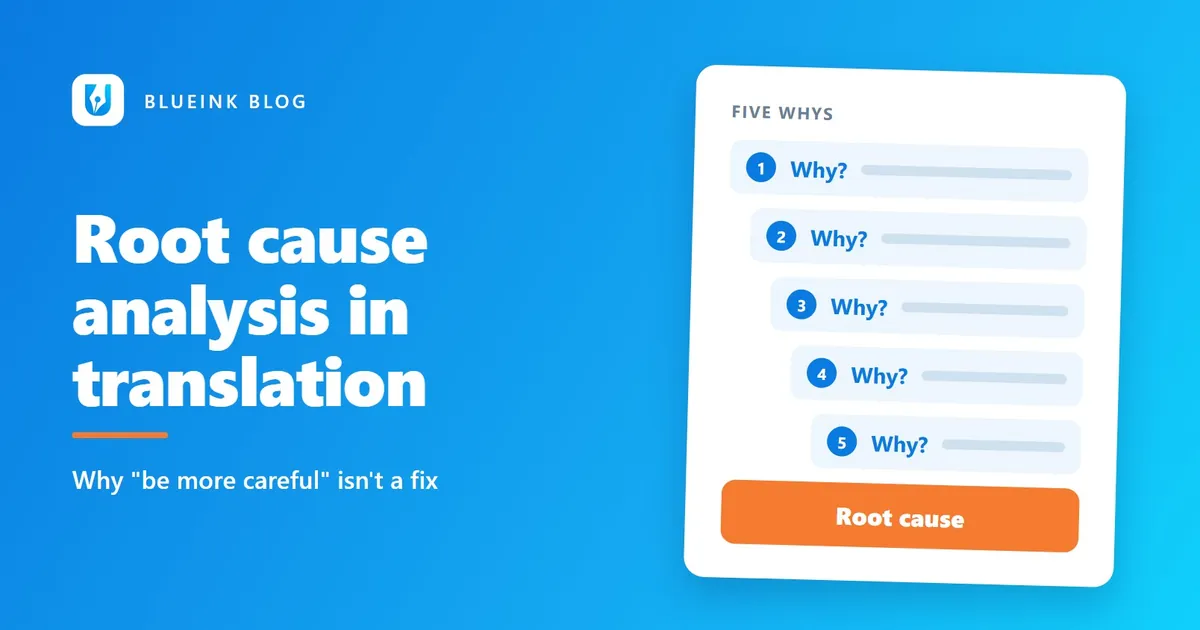
Root Cause Analysis in Translation: Fix the Process
Root cause analysis for translation errors: see the five whys on a sample error, where to stop and what corrective and preventive actions look like.
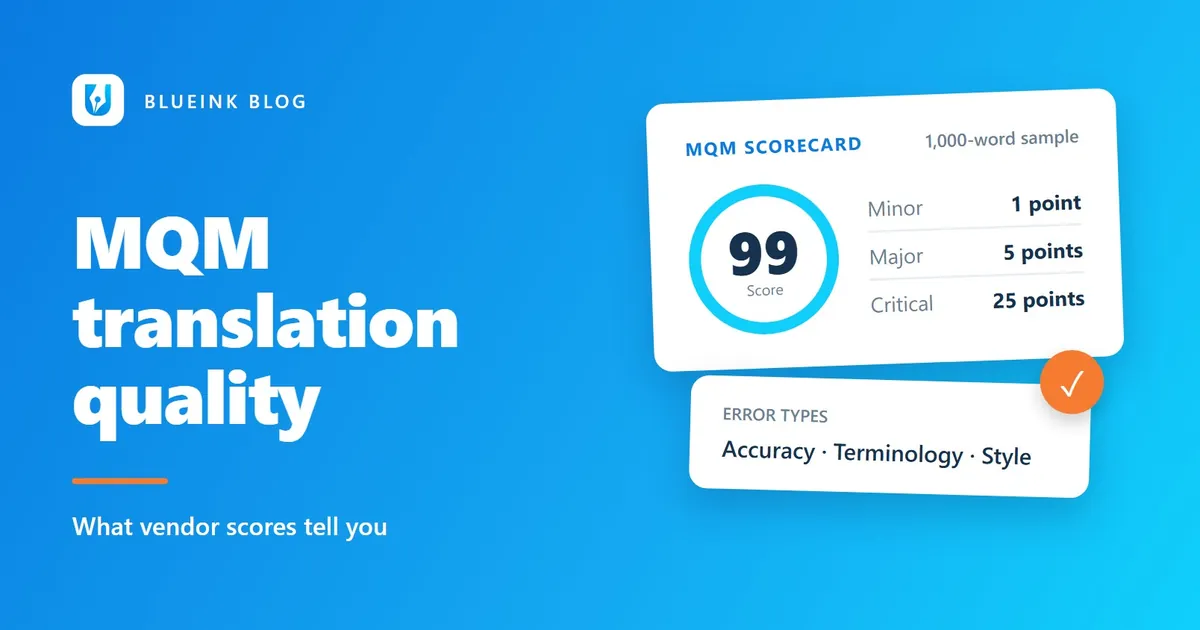
MQM Translation Quality: What Scores Tell You About a Vendor
MQM translation quality scores show how a vendor counts errors. Learn the error types, severity levels, what a good score means and what to ask.