Human Translation vs AI Translation: How We Decide
Human translation vs AI translation is not either-or. See the five questions that decide where AI assists, where people lead and who signs off.
Two documents arrive on the same day. One is a clinical trial consent form. The other is a set of product descriptions for an online store. Both need translating. Few people would say they should be handled the same way.
That instinct is the heart of this post on human translation vs AI translation. Software can speed up some translation work. It should not decide who signs off on a medical form. At Blueink, people stay at the center, and technology joins the work only where it adds speed or consistency without costing accuracy. Here is how that decision gets made.
Key Takeaways
- The question is not "human or AI". It is "which tasks suit which, and who is accountable for the result".
- Five questions decide where a task goes: the cost of an error, the reader, the repeatability, the rules and your permission.
- People lead anything legal, medical, regulatory or brand-critical, and a named expert owns every delivery.
- Always ask your vendor where AI is used, who checks the result and who owns it.
Why is "human translation vs AI translation" the wrong question?
It treats all translation as one task, and it is not. Translation covers a refund policy, a poem, a contract, a software menu and a safety warning. The risks and the reader's expectations differ for each.
A better question is what each piece of content needs. Some content needs speed and a consistent term list. Some needs judgment, cultural sense and a named person who answers for it. A sound process matches the task to the right mix.
Our traffic-light guide to AI translation sorts content types by risk. This post walks one example through the questions behind that sort.
What five questions decide where a task goes?
These questions help you, and your vendor, place any piece of content. Answer them in order.
1. What happens if this is wrong?
Start with the cost of an error. A typo in an internal memo is a small problem. A wrong dose, a wrong clause or a wrong legal date can cause harm, money loss or a failed filing.
The higher the cost, the more a qualified person must lead. For legal, medical or regulatory content, a certified linguist signs off.
2. Who is the reader, and what do they expect?
A reader who needs only the gist can accept rough wording. A customer reading your brand's homepage expects it to sound natural, confident and local. Tone and trust are at stake.
Marketing, slogans and brand voice call for human skill, often transcreation. That means recreating a message so it has the same effect locally. Our transcreation service exists for this kind of work.
3. Is the content repeatable?
Software helps most with high-volume content that repeats and follows stable terminology, such as product attributes or standard support articles. A glossary of approved terms makes the output more consistent.
One-off, creative or ambiguous text benefits less. It depends on context that is hard to capture in a term list.
4. Do rules require a person?
Some content must carry a human signature by rule. Certified translations, sworn statements and regulated documents are examples. Which rules apply depends on the country, the document and the receiving office. When a certificate is needed, a person provides it. Our guide to certified translation in India explains the basics.
5. Has the client agreed?
Permission matters. Your content may be confidential. You may have contractual limits on where it can be processed. Ask your vendor, and agree in writing, whether and how any technology may be used on your files.
How do the questions sort the two opening documents?
The consent form scores high on every question. An error could harm a participant. The reader must be able to trust it. Rules require a certified linguist. So people lead, and AI is not used to produce the translation.
The product descriptions score differently. An error is small and easy to correct. The text repeats, and a glossary can fix the terms. With your approval, a linguist can work from an AI draft and edit it, and a named expert still owns the result.
What does the result look like in practice?
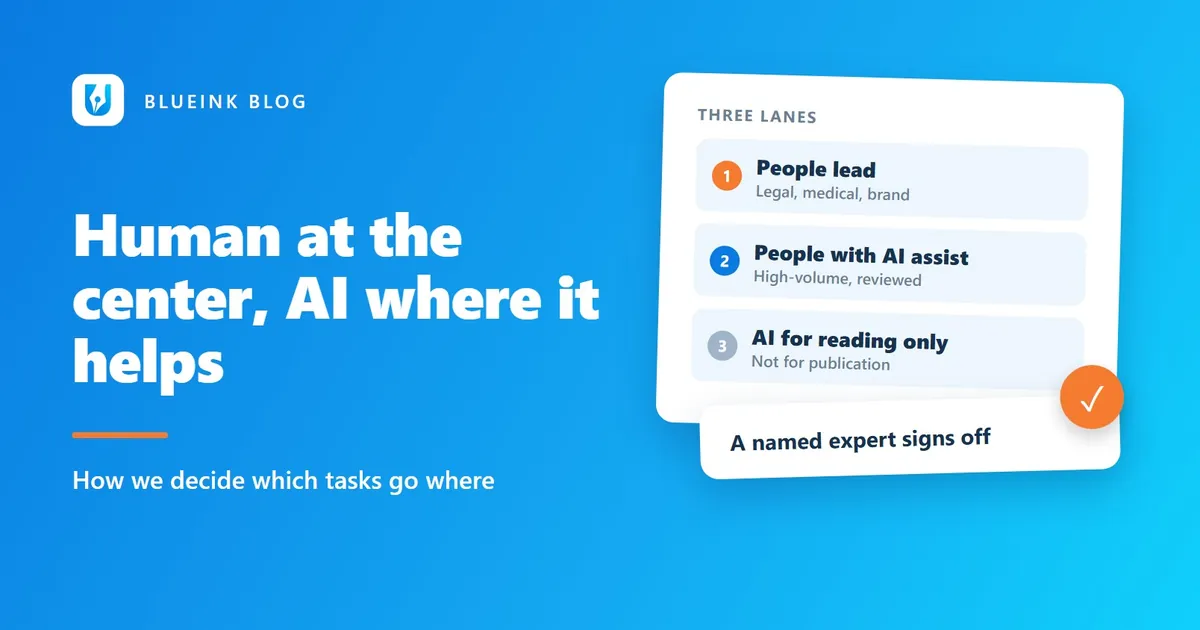
Here is how common content types usually fall, in three lanes. In the first lane, people lead. In the second, people lead and use AI assistance, with review. In the third, AI is used only for reading, never for publication.
| Content type | Lane | Who leads | Where AI may assist |
|---|---|---|---|
| Legal contracts, court documents | People lead | A qualified legal linguist | Not used to produce the translation. Reading or checks only, with your approval |
| Medical and regulatory documents | People lead | A certified linguist with subject knowledge | Not used to produce the translation. Reading or checks only, with your approval |
| Brand, marketing and slogans | People lead | A transcreation writer | Early idea generation, if you agree |
| Websites and software text | People with AI assist | A native linguist | First drafts and term checks, with human review and where your approval allows |
| High-volume support or catalog text | People with AI assist | A native linguist who reviews and edits | Drafting, where content and your approval allow |
| Internal material you only need to understand | AI for reading only | No translation needed, you read it yourself | Quick reading, not for publication |
The table is a starting point, not a rule. A short legal notice and a long contract can differ. The five questions still apply to each project.
Where do people always lead?
People lead wherever the cost of an error is high or trust is at stake. That covers legal, medical and regulatory content, and anything that speaks for your brand.
They also lead on judgment. Take Hindi, where the choice between "आप" (aap), the polite "you", and "तुम" (tum), the informal one, sets the whole relationship with the reader. A bank notice and a gaming app need different choices. Software can suggest one. A person who knows the audience decides.
Cultural sense is another. A joke, a color, a festival reference or a gesture can please one market and put off another. Software has no stake in how the reader feels. A human does.
Above all, a person is accountable. A named expert owns every project and every delivery, and AI never signs off.
Where can AI help?
AI helps with the work that is large, repeatable and rule-based. In those areas it can save time and improve consistency without taking judgment away from people.
Examples include:
- First drafts of high-volume, low-risk text that a linguist then edits.
- Term checks, to spot where a glossary term was not used.
- Consistency checks, to flag numbers, names or dates that differ across a document.
- Summaries, so a team can understand a long foreign-language document quickly.
Confidentiality still applies when AI is used only for reading, so check question 5 first. In each case, a person decides what to keep. AI assists. It does not replace the person who edits, contextualizes and owns the result.
How is quality checked?
Quality is checked in-house, by people, before a file reaches you. Every project has a named owner who answers for it. That holds whether or not technology touched the draft.
Good quality checks are specific. They look at accuracy, terminology, style and fit for the audience, and they record what they find. A scoring framework such as MQM sorts errors by type and severity, so you can see patterns and fix causes. Our plain-English guide to MQM explains how it works.
What should you ask any vendor?
Use these questions to cut through marketing language. A good vendor answers them plainly.
- Where do you use AI, and where do you not? Look for a clear line by content type.
- Who reviews the result? You want a named, qualified person.
- Who signs off on legal, medical or regulated content? The answer should be a certified linguist.
- What happens to my files? Ask about confidentiality and where content is processed.
- Can I opt out of AI for my content? You should be able to decide.
- How do you check quality, and can I see the results? Ask for specifics, not slogans.
The answers show whether technology serves the work or replaces the people doing it.
Frequently Asked Questions
Is human translation better than AI translation?
It depends on the content. People are better where judgment, culture, accountability or regulation matter. AI can help with large, repeatable, low-risk text. The best approach matches each task to the right mix, with a person responsible for the final result.
Can I use AI translation for legal or medical documents?
Not as the final version. Legal, medical and regulatory content should be translated and signed off by a qualified person. AI may help a team read or check material, but it should not stand in for certified work.
How do I know if my vendor uses AI on my files?
Ask directly, and ask for the answer in writing. Request details on which content types use AI, who reviews the output and how your files are handled. You should be able to agree or opt out.
Who is responsible for the quality of the translation?
A named person should be. At Blueink, a named expert owns each project, and quality is checked in-house before delivery. AI does not take responsibility for the result.
What should you do next?
List the content you translate and sort it using the five questions. Mark what a person must lead, what can use assistance and what is for reading only. Then share the list with your vendor and compare their approach to yours. Blueink offers document translation led by people, with technology used only where it helps. To talk through your content, write to projects@blueinki.com.
This is general information, not legal or regulatory advice.
Need help with document translation?
Tell us about your project and we will send a free, no-obligation quote.
More from the blog
What Is MQM? A Plain-English Guide to Measuring Translation Quality
"Good translation" is an opinion. MQM turns it into a measurable score you can track and improve.
Root Cause Analysis in Translation: Fix the Process
Root cause analysis for translation errors: see the five whys on a sample error, where to stop and what corrective and preventive actions look like.
Financial Translation Services: Keep Terms Consistent
Financial translation services work best with a glossary, translation memory and style guide. Learn how to keep terms consistent across documents.