
Root Cause Analysis in Translation: Fix the Process
Root cause analysis for translation errors: see the five whys on a sample error, where to stop and what corrective and preventive actions look like.
A translated label goes to print, and a buyer spots a mistake. The vendor replies, "We're sorry. We'll be more careful next time." That sounds reasonable. It is also a promise that changes nothing.
Carefulness is not a process. If the same conditions are in place next month, the same error can return. This post shows a better answer: root cause analysis, with the five whys method worked through on a sample error.
Key Takeaways
- Root cause analysis asks why an error happened until you reach a cause you can change, not a person to blame.
- "We'll be more careful" stops too early. It describes an intention, not a fix.
- A good fix has three parts: correct this error, change the process that allowed it, and check the same weakness elsewhere.
- Ask your vendor what changed after the last error, not whether they apologized.
What is root cause analysis in translation?
Root cause analysis is a structured way to find why a problem happened, so the fix targets the cause and not the symptom. In translation, a symptom is the wrong word on the page. The cause is whatever allowed that word to get there and reach you.
For translation buyers, root cause analysis separates a vendor who fixes one file from a vendor who improves how every file is handled. Blueink's linguistic testing includes root cause analysis for repeat issues, which is the same idea applied to ongoing work.
Our guide to MQM, short for Multidimensional Quality Metrics, explains how translation errors are scored by type and severity. Patterns in those scores can point to a fix.
How does the five whys method work?
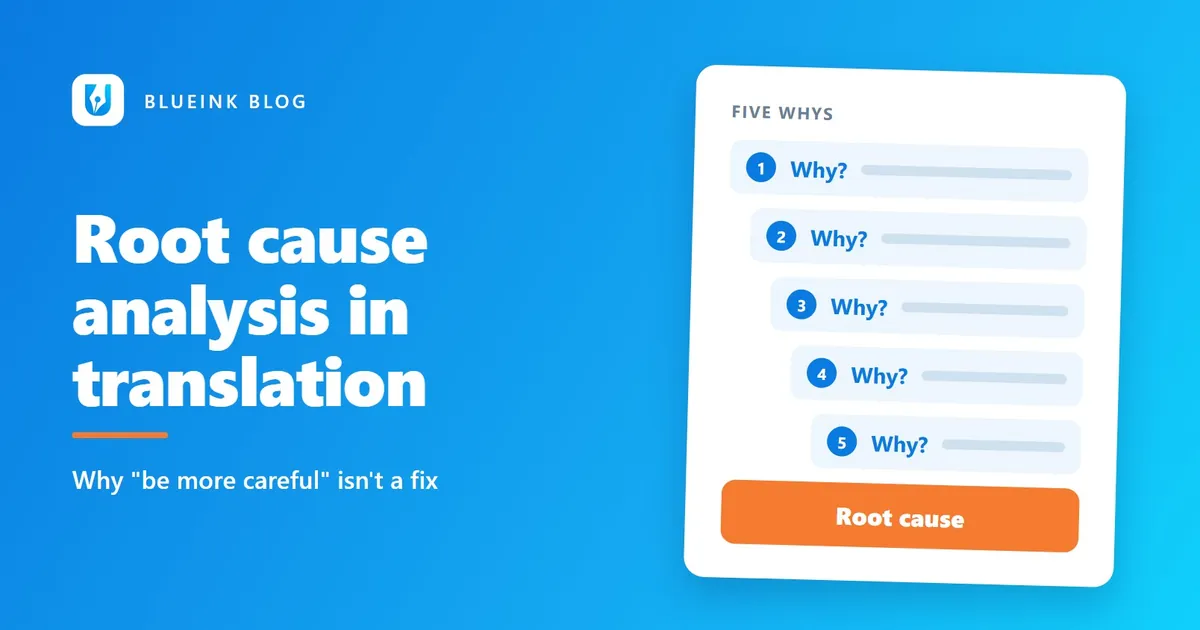
The five whys method means asking "why?" repeatedly about a problem, using each answer as the next question. It is associated with Taiichi Ohno and the Toyota Production System (Toyota Production System overview). The number five is a guide, not a rule. Some problems need three questions, others need seven.
Each answer should be a fact you can check. The chain ends when you reach a cause that is part of how the work is set up, and that you can change.
What does a five whys analysis look like on a sample error?
Here is a sample. This is an illustrative example, not a real client case. It is a composite built to show the method.
The problem: A translated product leaflet says "store above 25°C". The English source says "do not store above 25°C". The word "not" has disappeared in translation. A reviewer caught it after printing.
The first reaction is to blame the translator. The five whys shows why that is too early.
- Why did the word "not" vanish? The translator worked on "Do not" and "store above 25°C" as two separate pieces of text and joined them wrongly.
- Why were they separate pieces? The source file was exported from a design layout. The designer had split the sentence across two text boxes to fit the page.
- Why was the error not caught in review? The reviewer checked each translated piece against its matching source piece. Each piece looked fine on its own.
- Why did the review work piece by piece? The checklist for text files had no step for reading the finished page as a whole.
- Why did the checklist lack that step? It was written for plain text documents. Design files were added later, and nobody updated the checklist to match.
The root cause: The process had no rule for checking files where layout splits a sentence. The translator's slip was the trigger. It was not the cause.
Notice what the analysis did. A "be more careful" promise would have stopped at step 1 and pointed at a person. The real weakness was in the checklist.
How do you know when to stop asking why?
Stop when the answer is something you can change in how the work is done. Three checks help.
- A person is not a root cause. If an answer says someone was careless or rushed, keep asking. Why was the person rushed? Why did nothing catch it?
- Test the chain backward. Read it from the root up with "therefore". If each step follows logically, the chain holds. If a step feels like a leap, a cause is missing.
- Ask if fixing it would have prevented the error. If the cause had been fixed, would this error have been stopped or caught? If not, you have not reached the cause yet.
A problem can also have more than one cause. If an answer branches, follow each branch. Do not force a single line.
What do corrective and preventive actions look like?
A good response has three layers. They sound similar, so here they are in plain terms. Corrective action deals with a problem that has already occurred. Preventive action deals with a risk that has not (ASQ, "Back to Basics: Corrective vs. Preventive Action"). Many quality systems also list a first step, the correction, which is the immediate fix.
| Layer | What it does | Example from the leaflet |
|---|---|---|
| Correction | Fixes this one error now | Restore "not", re-check the whole leaflet, reprint |
| Corrective action | Removes the cause so it cannot repeat | Add a step to read the finished page against the source for every design file |
| Preventive action | Looks for the same weakness elsewhere | Check other formats where text can split, and update the notes you collect when a job starts |
Good actions are specific. "Review more closely" is vague. "A reviewer reads every design-file translation on the finished page, using the checklist, before release" can be done and checked.
Each action also needs an owner and a date. Without them, a fix becomes a hope.
How do you check that the fix worked?
Set a way to measure the result before you start. A fix with no check is a guess.
For the leaflet example, track whether errors of the same kind appear in later design-file projects over the next quarter. A scoring framework helps here. When errors are sorted by category and severity, you can see whether errors in the Accuracy category, meaning changes to the source meaning, go down for that file type.
If the same error returns, the analysis stopped too early. Go back to the chain and keep asking.
What should you ask your vendor about errors?
These questions show whether a vendor learns from mistakes.
- What was the cause of the last significant error? A specific answer is better than "human error".
- What changed in your process afterward? Look for a named step, checklist item or rule.
- Who owns the fix, and by when? A named person and a date show it is real.
- How do you check that it worked? Ask what they measure.
- Do you look for the same weakness in other projects? That is the preventive part.
An apology matters, but it is not a fix. The vendor who can answer these questions is the one who improves.
Frequently Asked Questions
What is the five whys method?
The five whys is a way to find a root cause by asking "why?" about a problem, then asking it again about each answer. It is associated with Taiichi Ohno and the Toyota Production System. Five is a guide, and the real aim is a cause you can change.
What is the difference between corrective and preventive action?
Corrective action addresses a problem that has already happened and aims to stop it from happening again. Preventive action addresses a risk that has not yet caused a problem. Both rely on knowing the real cause first.
Why is "we'll be more careful" not enough?
It describes an intention, and it usually blames a person. It does not change the process that allowed the error. If the conditions stay the same, the error can come back.
Does root cause analysis apply to every translation error?
Not always. A single minor typo may only need a correction. Use root cause analysis for serious errors, repeat errors and errors that reached the customer. The more serious or frequent the error, the more it is worth finding the cause.
What should you do next?
Pick one recent translation error in your own projects and run the five whys on it. Write each answer as a checkable fact, and stop only at a cause in the process. If you want help with that, or want to see how a vendor handles it, write to projects@blueinki.com. Our team reviews quality in-house and treats repeat issues as a process question.
The leaflet example is an illustrative composite, not a real client case.
Further reading
- Toyota Motor Corporation, Toyota Production System
- American Society for Quality, Back to Basics: Corrective vs. Preventive Action, Quality Progress
Need help with linguistic testing (mqm)?
Tell us about your project and we will send a free, no-obligation quote.
More from the blog
What Is MQM? A Plain-English Guide to Measuring Translation Quality
"Good translation" is an opinion. MQM turns it into a measurable score you can track and improve.
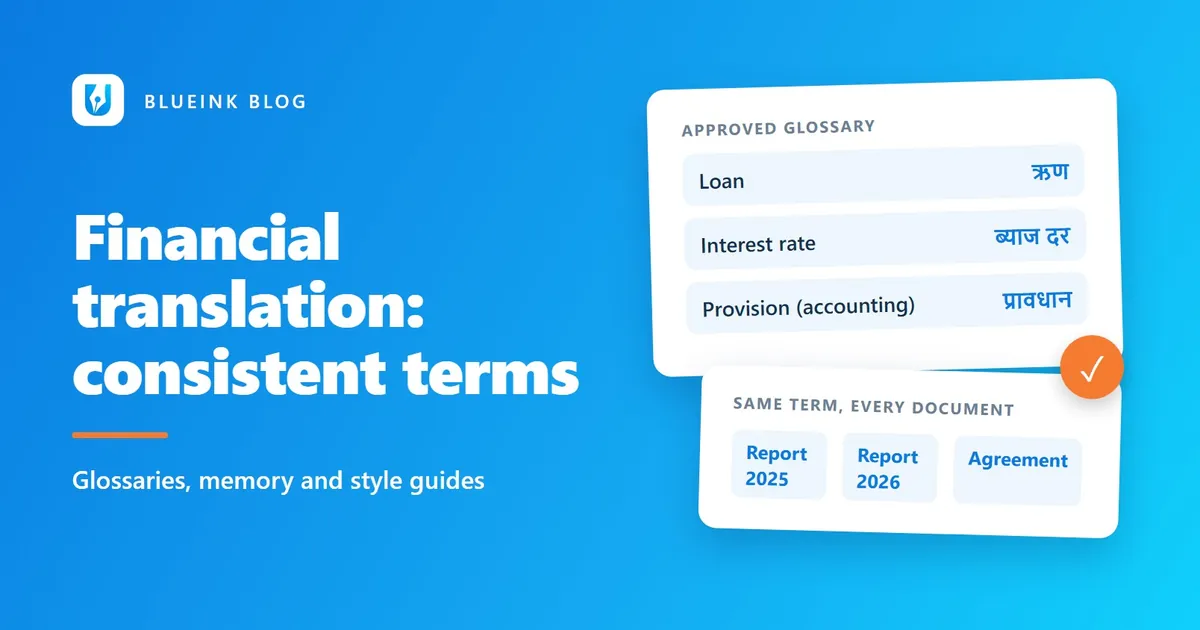
Financial Translation Services: Keep Terms Consistent
Financial translation services work best with a glossary, translation memory and style guide. Learn how to keep terms consistent across documents.
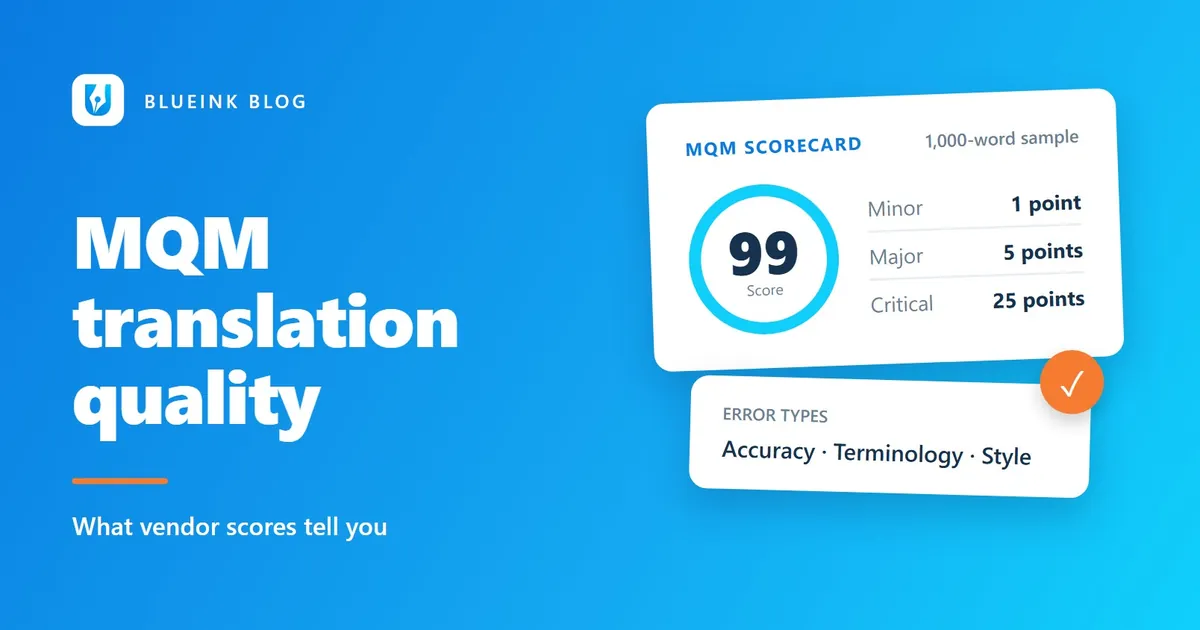
MQM Translation Quality: What Scores Tell You About a Vendor
MQM translation quality scores show how a vendor counts errors. Learn the error types, severity levels, what a good score means and what to ask.