
MQM Translation Quality: What Scores Tell You About a Vendor
MQM translation quality scores show how a vendor counts errors. Learn the error types, severity levels, what a good score means and what to ask.
A vendor tells you their translations score 98. Is that good? On its own, the number says very little. It only means something once you know what was counted, how heavily each mistake was weighted, and how much text was checked.
MQM, short for Multidimensional Quality Metrics, is the framework that answers those three questions. This post explains it for buyers, not linguists. It covers the error types, the severity levels, what a good score looks like and what to ask a vendor.
Key Takeaways
- MQM (Multidimensional Quality Metrics) sorts every translation error by type and by how serious it is, then turns the count into a score.
- A score is only meaningful alongside its sample size, its error weights and a pass mark set for your type of content.
- There is no universal "good" score. The MQM Council's own examples range from 97.2 for help content to 99.5 for legal text.
- Ask who scored the sample, how many words were checked and what counts as an automatic fail.
What does MQM actually measure?
MQM measures the errors a reviewer finds in a translation, and how much each one matters. A trained reviewer reads a sample of the text and marks every problem. Each mark gets a category (what kind of mistake) and a severity (how bad it is). The framework is maintained by the MQM Council, and our plain-English guide to MQM covers the basics.
The result is closer to a report card than a gut feeling. Because the rules are written down, scores are easier to compare. That is what makes MQM useful when you compare vendors or track one vendor over time.
What are the MQM error categories?
MQM 2.0 groups errors into seven top-level categories (MQM Council, error typology). Here they are in everyday terms, with an example from the languages Indian businesses often work in.
| Category | What it means for you | Example |
|---|---|---|
| Accuracy | The meaning is changed, left out or added | A dosage of "twice daily" appears as "once daily" in Hindi |
| Terminology | A term is wrong or inconsistent with your approved words | "Cart" is translated two different ways in a Tamil app |
| Linguistic conventions | Grammar, spelling or punctuation is wrong | A Marathi sentence has the wrong verb ending |
| Style | Correct, but not in your brand's voice | A Hindi page uses informal tum where your brand uses polite aap |
| Locale conventions | Dates, numbers or currency do not follow local format | "03/04/2026" is meant as 3 April, but a US reader sees March 4 |
| Audience appropriateness | The content does not suit the target audience or market | A reference that only makes sense in one country |
| Design and markup | Layout or formatting breaks | Longer Hindi text spills out of a button |
You may meet older names. MQM version 1 called Linguistic conventions "Fluency" and Audience appropriateness "Verity". A vendor using either set of names is likely describing the same ideas.
One detail matters for buyers. MQM Accuracy asks whether the translation matches the source. It does not ask whether the source itself is factually right (MQM Council, scoring models). A faithful translation of a wrong sentence is not an Accuracy error.
How serious is each error? Severity levels explained
Severity decides how much a mistake costs in the score. The MQM Council defines four levels on its scoring page.
- Neutral: the reviewer would have chosen a different wording, but the translation is acceptable. It carries no penalty.
- Minor: the reader can still understand and use the text. The impact is small.
- Major: the error seriously affects understanding, reliability or usability, or sits in a highly visible part of the content.
- Critical: the content is unfit for its purpose, or the error risks serious physical, financial or reputational harm.
The Council notes that "in many systems, a single Critical Error would automatically trigger a Fail Rating." Three levels, or even two, are also common, so check which scale your vendor uses.
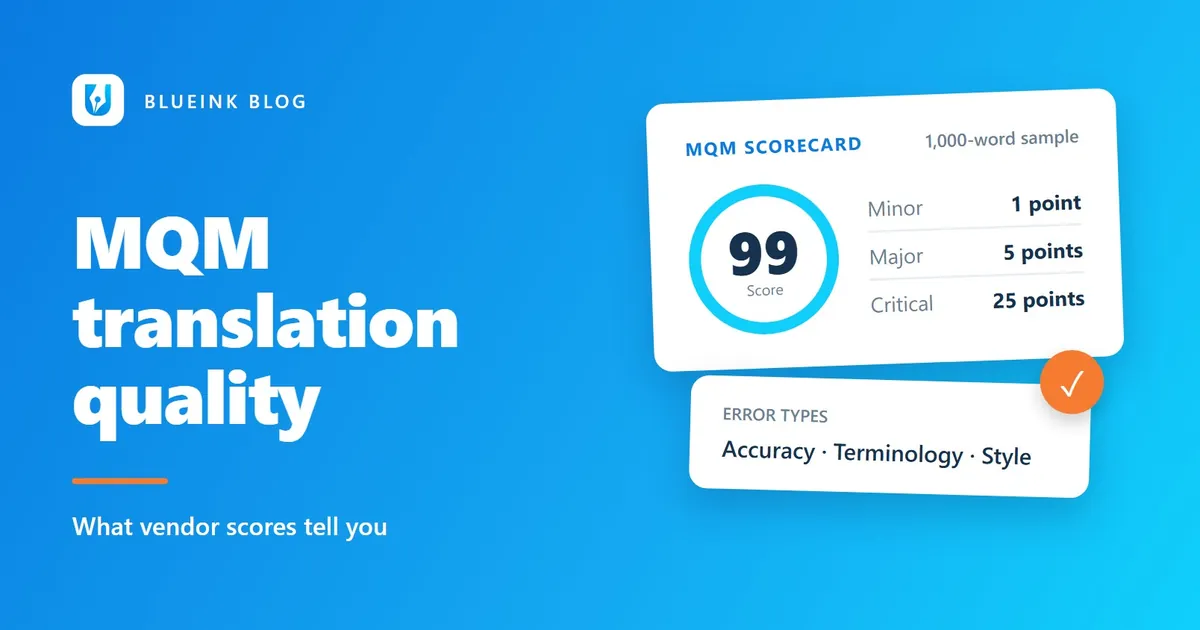
The weights are deliberately uneven. The Council's recommended multipliers are 0 for Neutral, 1 for Minor, 5 for Major and 25 for Critical (MQM Council, weighting guidance). One Major error counts as much as five Minor ones, and one Critical error counts as much as five Major ones.
Take the dosage error above. In a medicine leaflet, "twice daily" turned into "once daily" is a Critical error, because it could harm a patient. The same slip in an internal newsletter would be a much lighter matter. Severity depends on what the content is for.
How is an MQM score calculated?
The calculation is simple arithmetic, and you do not need a spreadsheet to follow it.
- The reviewer adds up the penalty points: 1 for each Minor error, 5 for each Major and 25 for each Critical.
- That total is divided by the number of words reviewed. Results are usually scaled to 1,000 words, so samples of different sizes can be compared.
- The penalty points per word, shown as a percentage, are subtracted from 100. A perfect sample scores 100.
The Council's own worked example: 10 Minor errors, or 2 Major errors, per 1,000 words gives a score of 99. Each case adds up to 10 penalty points across 1,000 words. That is 1 percent, and 100 minus 1 is 99. This unadjusted result is what MQM calls the raw score.
This shows why the sample matters. The Council says evaluators commonly work with samples of 500 to 20,000 words. A tiny sample can look spotless by chance. A larger one gives a steadier picture of the real quality.
What does a good MQM score look like?
A good score is the one that fits your content and your risk. MQM does not set a single pass mark. A pass mark is the lowest score you will accept. The team running the review decides it at the start of a project, by choosing how many penalty points per 1,000 words are acceptable.
The Council gives two illustrations. A raw score of 99.5 for legal translation allows about five penalty points per 1,000 words. A score of 97.2 for technical help content allows about 28. These are examples of how thresholds can differ, not industry standards.
That gap makes sense. A contract clause or a clinical instruction leaves little room for error. A help-center article can tolerate a few small slips and still do its job.
So when a vendor quotes "98", ask whether that score is above or below the pass mark for that kind of content. Using the Council's example thresholds, a 98 clears the bar for a help article but not for a legal agreement.
What should you ask a vendor about their MQM scores?
Scores are only as trustworthy as the process behind them. These questions help you test it.
- How many words did you review, and how were they chosen? A sample drawn from your real content is more telling than a hand-picked one.
- Who scored the sample? Look for a trained reviewer, ideally one who did not produce the translation.
- What pass mark do you use for my content type, and why? A clear reason matters more than the figure.
- Which severity scale and weights do you use? Confirm whether it is the Council's 1-5-25 scheme or a custom one.
- What triggers an automatic fail? For regulated or safety-related content, one Critical error should usually be enough.
- Can I see the scores by category? A breakdown shows whether problems are in meaning, terminology or style, so you know where to fix things.
- What happens when a sample misses the pass mark? You want a defined correction step, not a shrug.
Good answers are specific. Vague ones, like "we follow industry standards", tell you the number was not built on a method.
Where do people fit in MQM scoring?
People sit at the center of it. A score is only as sound as the reviewer who assigns it. Spotting a wrong dosage or a clumsy honorific takes a trained linguist. So does catching a term that clashes with your glossary. Software can help count and organize errors, but a person decides what each one is and how serious it is.
This is also why a score never replaces your own judgment. It is evidence about quality, gathered by a person under agreed rules. At Blueink, quality is checked in-house, and our linguistic testing service applies MQM to your content with a named person accountable for the result.
Frequently Asked Questions
What does MQM stand for?
MQM stands for Multidimensional Quality Metrics. It is a framework for classifying translation errors by type and severity and turning them into a score. The MQM Council maintains it.
Is a higher MQM score always better?
A higher score means fewer weighted errors, but it needs context. Compare scores only when the sample size, weights and content type match. A 98 on marketing copy and a 98 on a clinical document are not the same achievement.
What is a passing MQM score?
There is no single passing score. Teams set a pass mark per project based on risk. The MQM Council's examples include 99.5 for legal translation and 97.2 for technical help content.
Does MQM work for every kind of content?
It applies to most content types, including documents, websites and software, and categories such as Design and markup cover layout problems. The pass mark and sample should still match the content. A regulated medical translation needs a stricter threshold than a blog post.
What should you do next?
Ask your current or prospective vendor the seven questions above and compare the answers. If you want an independent view of translation you already have, share a sample. We will explain each error and how serious it is. Write to us at projects@blueinki.com.
Figures from the MQM Council were checked against its pages when this post was written. This is general information, not legal or regulatory advice.
Sources
- MQM Council, MQM error typology
- MQM Council, MQM scoring models
- MQM Council, Severity weighting guidance
Need help with linguistic testing (mqm)?
Tell us about your project and we will send a free, no-obligation quote.
More from the blog
What Is MQM? A Plain-English Guide to Measuring Translation Quality
"Good translation" is an opinion. MQM turns it into a measurable score you can track and improve.
Root Cause Analysis in Translation: Fix the Process
Root cause analysis for translation errors: see the five whys on a sample error, where to stop and what corrective and preventive actions look like.
Financial Translation Services: Keep Terms Consistent
Financial translation services work best with a glossary, translation memory and style guide. Learn how to keep terms consistent across documents.