AI vs Human Translation for Business: A Traffic-Light Guide
Which business content can go through AI translation, and which needs a linguist? A green, amber and red guide by content type, with 2025 evidence.
AI translation is fast and cheap, and for some business content it is good enough. For other content, one wrong word can void a contract or harm a patient. The useful question is not "AI or human?" but "which content, in which language, for which reader?"
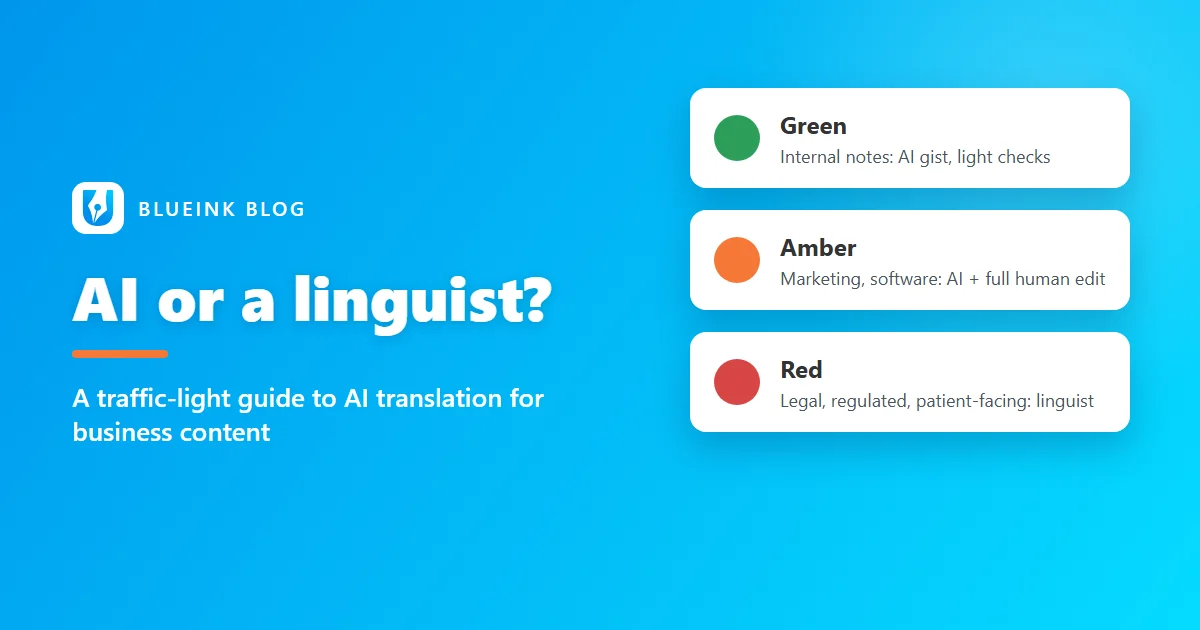
This guide gives you a traffic-light system for that decision. Green content can go through AI with light checks. Amber content needs AI plus full human editing. Red content needs a qualified linguist from the start.
Key Takeaways
- Sort content by three tests: who reads it, what a mistake would cost and which language pair it uses.
- Language pair matters. A 2025 JAMA Network Open study found AI performed similarly to professionals in Spanish but made far more serious errors in Chinese and Vietnamese.
- AI plus a qualified human reviewer can work well for amber content, but it still needs a person who owns the result.
- Keep legal, regulated and patient-facing text red: human translation, independent review and a named person who signs off.
What is the difference between AI translation and human translation for business?
AI translation means software produces the target text. Human translation means a professional linguist writes it. Most real projects sit between the two. "Machine translation" usually means a dedicated translation engine. "AI translation" now also covers large language models that can follow instructions and glossaries.
The middle ground is post-editing: a linguist corrects machine output until it meets an agreed standard. ISO 18587:2017 sets requirements for full human post-editing of machine translation output. ISO 17100:2015, the translation services standard, says "the use of raw output from machine translation plus post-editing is outside the scope" of that standard.
For a buyer, the practical difference is accountability. Software produces text quickly. A linguist can explain each choice, check it against your glossary and answer for the result.
How does the traffic-light system work?
Score each piece of content against three tests, then let the strictest result decide the colour.
- Who reads it? Your own team, customers, a court, a regulator or a patient.
- What does a mistake cost? Mild confusion, a lost sale, a legal dispute or physical harm.
- Which language pair? AI quality varies widely between languages, as the next sections show.
Official bodies draw similar lines. The European Commission's page "Use of machine translation on Europa" says machine translation "can give you a basic idea of the content". It also advises against using its own machine translation service for EU legislation. In the United States, a 2024 federal health rule calls for human review in some cases. We cover it below.
These positions are context, not rules for your business. They show where public bodies themselves stop trusting raw AI output.
Which content is green, amber or red?
Most business content falls into one of three tiers. Internal notes are usually green. Marketing and software text are usually amber. Legal, regulated and patient-facing content is red. The table gives an example in a named language for each type. If one document mixes tiers, such as a sales deck with a contract annex, treat it as the strictest tier.
| Content type | Tier | Example | What it needs |
|---|---|---|---|
| Internal notes and emails | Green | Reading the gist of a Japanese supplier email in English | AI output, marked as machine-translated; ask a linguist if you will act on details |
| Marketing and campaigns | Amber | A Spanish (Mexico) campaign headline built on an English pun | AI draft only as a starting point; a native copywriter adapts it, often as transcreation |
| Software and website text | Amber | German interface strings that run longer than English and contain placeholders | Glossary, full human edit, then in-context checks, as in website localization |
| Legal | Red | An Arabic contract clause on liability | Human translation by a legal linguist, plus independent review |
| Regulated | Red | A Hindi patient consent form for a clinical trial in India | Human translation, independent review and the method your sponsor or ethics committee expects |
| Patient-facing | Red | Gujarati discharge instructions for a hospital | Human translation by a medical linguist, plus independent review |
The tier can move. An internal note becomes amber if it goes to a customer. A product page becomes red if it makes a safety or health claim. Re-check the colour whenever the reader or the risk changes. Whatever the tier, check your data policy before pasting confidential text into any AI service.
Does the language pair change the colour?
Yes. The same AI system can be reliable in one language and risky in another. A 2025 study in JAMA Network Open (Martos et al.) compared AI and professional translations of pediatric discharge instructions from one US children's hospital. It analysed "148 sections from 34 discharge instructions". The AI system was a neural machine translation service.
In Spanish, 7% of sections had clinically impactful errors in both AI and professional versions. In Simplified Chinese, the figures were 52% for AI and 20% for professionals. In Vietnamese, they were 41% and 14%. Somali showed the widest gap: 92% against 13%.
The European Commission makes the same point: machine translation quality "can vary significantly from one text to another and between different language pairs". The WMT25 shared task (2025) still used professional annotators to judge systems. Its preliminary ranking notes that "learned metrics struggle with low-resource languages, such as English-to-Bhojpuri". For such languages, assume amber or red until a linguist has tested the output.
What does a safe amber workflow look like?
A safe amber workflow uses AI for the first draft and a qualified human for everything that follows. A 2025 study in npj Digital Medicine tested this on discharge instructions in six languages, including Arabic, Bengali and Spanish. Reviewers preferred the human-in-the-loop versions over professional-only translations (46.5% against 28.4%). Average time was 7.1 minutes against 16.8. AI used alone gave "variable performance", with the poorest ratings in Armenian and Somali. This was controlled research, so live patient-facing text still stays red.
That result depends on the human step. A workable amber process looks like this:
- Agree a glossary and style notes before any text is translated.
- Produce the AI draft with that glossary.
- A native linguist edits every sentence, not a sample.
- Run checks on numbers, names, placeholders and terminology.
- A named person reviews and signs off.
Measure the result with a scoring model such as MQM (Multidimensional Quality Metrics), so quality is checked rather than assumed.
Why do legal, regulated and patient-facing texts stay red?
Because the reader may rely on every word, and someone must answer for it. The clearest official example, for US health programs serving people with limited English proficiency, is US federal rule 45 CFR 92.201(c)(3). It comes from the HHS final rule "Nondiscrimination in Health Programs and Activities", published on 6 May 2024 and effective 5 July 2024. It says machine translation must be "reviewed by a qualified human translator" when "accuracy is essential". It also covers rights-critical and technical text.
Courts have paused parts of that rule, so check its current status.
The European Commission's machine-translation page adds that it "does not guarantee the accuracy and accepts no liability for possible errors". Legal and regulated work may also need a certified translation, which starts with specialist document translation. Our guide to certified translation in India explains when. For these documents, start with a specialist linguist and add an independent reviewer.
Who signs off when AI is part of the workflow?
A person, always. AI can draft, suggest and check, but it cannot be accountable for a translation. Before a project starts, name the person who will approve the final text in each language. That person should be qualified in the language pair and the subject.
This is how we work. We never let AI sign off. A named expert owns every project, and quality is checked in-house before delivery. We use AI and other technology only where it adds speed or consistency.
When you brief any translation team, ask three questions. Which steps use AI? Who edits the output, and how much of it? Who signs off, and can you see their name? Clear answers to those questions matter more than any promise about the tool.
Frequently asked questions
Is AI translation good enough for internal documents?
Often, yes. For internal notes, emails and research you only need to understand, AI translation usually gives a fast, useful gist. Treat it as green content: label it as machine-translated and keep it inside the team. Ask a linguist to check any detail you plan to act on, such as a price, a date or a commitment. If the document will later go to a customer, partner or authority, it moves to amber or red. Plan the human review before that happens, not after a problem appears.
Can AI translation be used for legal contracts?
Not without a qualified legal linguist. A contract is red content: one wrong term can change who is liable, for what and under which law. Reading the AI gist of a foreign-language contract can be green, because nobody signs or relies on that text, provided your data policy allows it. The version that anyone signs, files or relies on should be translated by a legal linguist and reviewed by a second one. If an authority asks for a certified translation, follow its rules for who may certify it.
Is post-edited AI output as good as human translation?
It depends on the content tier, the language pair and the reviewer, and there is no guarantee either way. For amber content edited in full by a qualified native linguist, post-edited output can be fit for purpose. The 2025 npj Digital Medicine study found reviewed AI drafts were often preferred. For red content, start with a qualified linguist. Judge every translation by the same agreed quality checks, whichever method produced it. Record which method you used, so you can trace any problem later.
What should you do next?
List your content types and give each one a colour using the three tests: reader, cost of a mistake and language pair. Agree the workflow for each colour before the next project starts. Name the person who will sign off in every language.
For mixed content, start with your highest-risk documents and work down. Our guide to localization vs translation can help you decide how much adaptation each type needs.
Blueink offers document translation. Get an instant quote at blueinki.com.
This is general information, not legal or regulatory advice. The HHS rule and the European Commission page are cited as context only; check current requirements with your legal or regulatory adviser.
Sources
- Martos et al., Accuracy of Artificial Intelligence vs Professionally Translated Discharge Instructions, JAMA Network Open, 17 September 2025, doi:10.1001/jamanetworkopen.2025.32312 (free full text on PubMed Central)
- Evaluating human-in-the-loop strategies for artificial intelligence-enabled translation of patient discharge instructions: a multidisciplinary analysis, npj Digital Medicine 8:629, 24 October 2025
- Kocmi et al., Findings of the WMT25 General Machine Translation Shared Task, Proceedings of the Tenth Conference on Machine Translation, November 2025; and the WMT25 preliminary ranking, August 2025
- US Department of Health and Human Services, Nondiscrimination in Health Programs and Activities, final rule, 89 FR 37522, published 6 May 2024, effective 5 July 2024; text of 45 CFR 92.201 (Cornell LII)
- European Commission, Use of machine translation on Europa (commission.europa.eu, "Languages on our websites" section; page undated, retrieved 13 November 2026)
- ISO, ISO 17100:2015 Translation services (iso.org catalogue entry, checked 10 November 2026)
- ISO, ISO 18587:2017 Post-editing of machine translation output (iso.org catalogue entry, checked 10 November 2026)
Need help with document translation?
Tell us about your project and we will send a free, no-obligation quote.
More from the blog

9 Reasons to Hire a Certified Translator for Your Legal Documents Translation
When your legal documents need translating, choosing a certified translator is crucial. This task isn’t just about changing words; it’s about ensuring your documents maintain their legal integrity in any language.
Certified Translation in India: When You Need It and What to Ask For
Visa, university and court applications often ask for a certified translation. Here is what that means and how to order one.
Localization vs Translation: What's the Difference, and Which Do You Need?
Translation changes the words. Localization changes the whole experience. Here is how to tell which one your content needs.