
Game Localization Transcreation: Why Games Need It
How humor, names and lore break under literal translation in games, and how transcreation and linguistic testing protect the player.
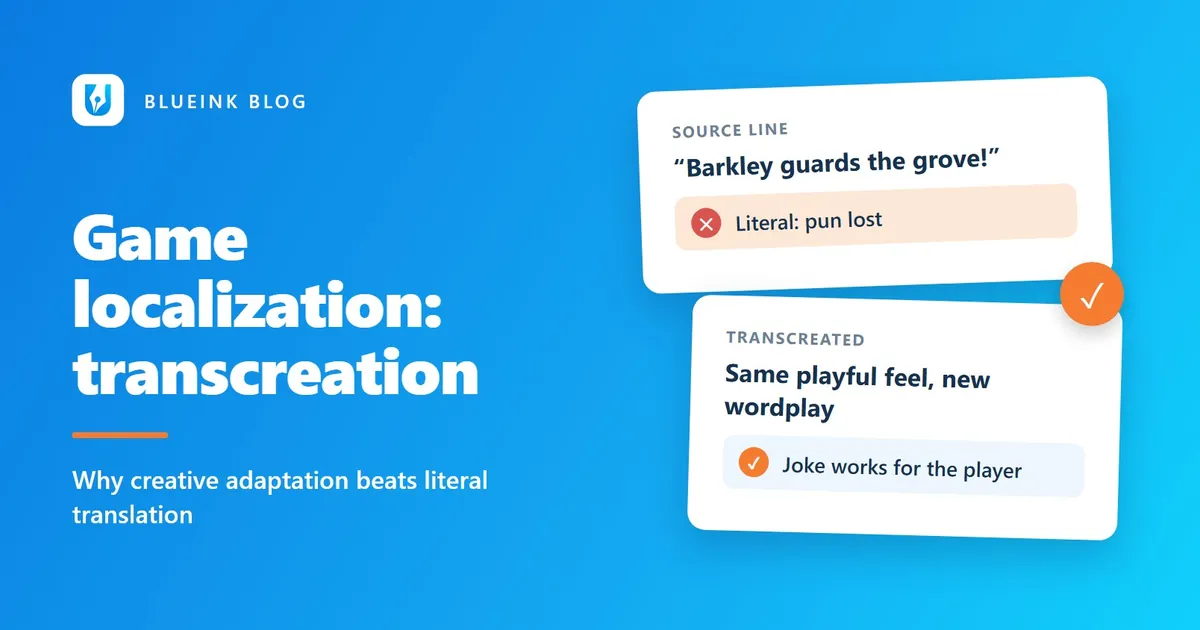
Game localization transcreation starts with a simple problem. Picture a hero in an English fantasy game whose name is also a pun. The joke lands every time a player says it aloud. In the translated version, the name is carried over word for word. The pun vanishes, the joke dies and the character becomes just another label.
Games depend heavily on feeling. Players stay when the humor, the story and the world feel real to them. That is why game teams that care about player experience often look to transcreation, not plain translation.
Key Takeaways
- Translation moves meaning between languages. Transcreation recreates the effect, so a joke, a name or a mood works for the new player.
- Humor, character names and lore are common places where literal translation fails.
- Games need context. A line of dialogue means little without the scene, speaker and player choice around it.
- Test the game in the language, in play, before release.
What is game localization transcreation, and how is it different from translation?
Translation carries the meaning of a text into another language as faithfully as it can. Transcreation, a blend of "translation" and "creation", rewrites the message so it has the same effect on the new audience, even if the words change. Blueink describes transcreation as the creative adaptation of slogans, ads and campaigns for a local audience.
Both have their place. A settings menu needs clear, accurate translation. A villain's taunt, a pun-based quest title or a funny item description needs transcreation. The skill is knowing which text needs which.
The W3C describes localization as adapting a product, application or document content to the language and culture of a specific market (W3C). Games sit at the creative end of that range. Our guide on when literal translation fails your brand covers the wider idea.
Here is how the two approaches usually divide up game text.
| Type of game text | Approach | Why |
|---|---|---|
| Menus, settings and instructions | Accurate translation | Clarity matters most |
| Dialogue and story | Transcreation where tone matters | Voice carries the scene |
| Jokes, puns and slang | Transcreation | Wordplay often does not carry over |
| Character and place names | Decide case by case | Names carry personality |
| Marketing and store text | Transcreation | It must persuade local players |
Humor breaks in literal translation
Humor depends on the sound, the culture and the timing, and literal translation preserves none of them. A pun works because two meanings share one sound in one language. Another language rarely has the same pair.
Take a dog-like forest guard called "Barkley". This is an invented example. His name is a pun, because "bark" is both the sound a dog makes and the outer layer of a tree. In Hindi, those two meanings are different words, so a direct translation loses the pun. A transcreator asks what the pun did. It made the guard sound both loyal and rooted in the woods. They look for a Hindi name or nickname that does the same job, even if it has no link to barking.
References change too. A joke about a local sport or a TV show will not carry. The transcreator may replace it with one that players know, or rework the line so it is funny without a reference.
Character names are design, not words to convert
Names carry personality, so treat them as design, not as words to convert. A name can signal strength, comedy, age or origin. Some names should stay as they are. Others should change.
There are three common choices:
- Keep the name. This works for names that are already known, or that sound distinctive in any language.
- Transliterate it. The name is written in the new script so it can be read and said. This fits names with no special meaning.
- Recreate the name. If the name has meaning that matters to the character, find one that does the same job in the new language.
Whatever you choose, apply it everywhere: dialogue, menus, trailers and store pages. A character with two names across the game confuses players. A shared glossary prevents that, much as it does for financial terminology, where one term must mean one thing across every document.
Lore and tone need the most consistency
Lore is the history, the places and the rules of a game world, and it needs the most consistency. Players notice when a place is spelled differently in two quests or when a magic item changes name between chapters. Players notice.
Tone is the other half. A gritty war game and a cheerful puzzle game use different voices. Even within one game, a wise old mentor does not speak like a street thief. Hindi has polite and informal forms of "you", and Japanese has levels of politeness that signal rank and relationship. A voice that is wrong for the character breaks the illusion.
Gamer slang needs special care. Words like "noob" or "GG" may stay in English in some communities and sound odd in others. Players in each market have their own habits. A transcreator who plays games, or works with someone who does, will know what sounds natural.
Context decides the quality of a game translation
Games hand translators strings, which are short snippets of text stored in the game's code, with no scene attached. A single line such as "You won!" might appear on a screen with no information about who is speaking or who is being addressed. That is a problem in many languages.
Here is a common example. In Hindi, verbs change with gender. "You won" can be "tum jeet gaye" for a male player or "tum jeet gayi" for a female player. If the game does not tell the translator whether the player's gender is known, the translator has to guess. Better to say so, and to ask for a wording that works for both when it is not known.
Good practice is to give translators as much as you can:
- Screenshots or short clips for each string.
- Speaker and listener notes for dialogue.
- Character limits for buttons and labels.
- A style guide for tone and a glossary for names and lore.
Context also helps with voice-over, where line length and timing must fit the animation. Our multimedia localization service covers voice-over, subtitling and dubbing, including for games.
What should a transcreation brief include?
A good brief turns a creative task into something a writer can act on. Without one, the writer guesses at your intent, and guesses are expensive in a game.
Include these items for each piece of creative text:
- The intent. What should the player feel: amused, tense, proud? State it in plain words.
- The character. Who is speaking, how old are they and how do they treat the player?
- The audience. Describe the players: age range, platform and what they already know about the game.
- The limits. Give character counts, voice-over length and any words that must not change.
- The freedom. Say how far the writer may go. Some teams allow a new joke. Others only want the same joke reworked.
Ask for more than one option on key lines, such as the title, the tagline and the main character's catchphrase. Then review them with someone who plays your genre. A short round of feedback at this stage costs little and keeps the tone consistent across the whole game.
Test the game in play, not in a spreadsheet
Testing in the game itself catches what a spreadsheet cannot. A translated line can read well on its own and still fail in play. Text may be cut off in a speech bubble. A joke may land after the wrong scene. A character may be addressed with the wrong politeness level.
A good test plays the game in the target language, as a player would. Testers check text fit, context, tone, consistency and function. Our linguistic and localization testing service uses native-speaking testers to review localized content in context.
Plan testing early. A build is a test version of the game, and it is still changing. Fixing a name or a joke at that stage usually costs less than fixing it after launch. If your game runs on phones, our mobile app localization guide for India lists the layout and script checks that matter on small screens.
If you use game-style quizzes in training, our e-learning localization checklist covers quizzes, examples and voice-over.
Frequently Asked Questions
What is game localization?
Game localization adapts a game for players in another language and region. It covers text, voice-over, names, humor, interface and store pages, so the game feels made for them. Translation is one part of it.
What is transcreation in game localization?
Transcreation recreates a message so it has the same effect on the new audience, even if the words change. In games it is used for jokes, names, slogans and story moments, where literal translation would lose the intended feeling.
Do I need transcreation for the whole game?
No. Menus, settings and instructions usually need accurate translation. Transcreation is for creative content such as dialogue, humor, character names, marketing text and story-critical moments. A localization partner can help sort the text.
How do you test a localized game?
Native speakers play the game in the target language and check text fit, context, tone and consistency. They record issues with screenshots so developers can fix them. Testing is best done before release.
What should you do next?
Start by sorting your game text into two piles: text that must be accurate, and text that must be felt. Then prepare context for the second pile, with screenshots, character notes and a glossary. Blueink offers game localization that is creative and culturally adapted, with quality checked in-house. To discuss your game, write to projects@blueinki.com.
The "Barkley" example is invented to illustrate the idea.
Further reading
- W3C Internationalization, Localization vs. Internationalization
Need help with game localization?
Tell us about your project and we will send a free, no-obligation quote.
More from the blog
Mastering the Art of Marketing Content Translation
When it comes to translating content, there are different approaches for different types of content.
Localization for Streaming Services: Bridging the Entertainment Gap
In today’s digital age, streaming services have revolutionized the way we consume entertainment.
Transcreation: When Literal Translation Fails Your Brand
A great tagline in English can fall flat, or worse, in another language. Transcreation keeps the feeling, not just the words.