Medical Translation: Back-Translation, Validation and Review
Medical translation needs more than one translator. Learn how back-translation and linguistic validation work, and what reviewers should check.
A dosage instruction that reads well but means something slightly different is a patient-safety problem. That is why medical translation uses checks that most other content never needs. Two of the best known are back-translation and linguistic validation.
This guide explains what each method does, when it fits and what a reviewer should check before a translated medical text is released. It quotes the regulations and standards directly, so you can check them yourself.
Key Takeaways
- The rules and guidelines quoted here ask for information that patients can understand. India's NDCT Rules and the EU device regulation also refer to the language. They set the result, not the method.
- Back-translation checks meaning. An independent translator turns the translation back into the source language, so changes in meaning show up.
- Linguistic validation is a fuller process for patient questionnaires. The ISPOR task force describes ten steps, including testing with patients in the target country.
- Reviewers should check meaning, numbers and units, terminology, readability and the source version, then grade each error by severity.
Why does medical translation need extra checks?
Because the reader may act on every word. A consent form, a questionnaire or a device label only works if the patient understands it as the source intends. Regulations and guidelines express this as a plain-language requirement. The table quotes four of them.
| Source | What it says | Applies to |
|---|---|---|
| International Council for Harmonisation (ICH) E6(R3) Good Clinical Practice guideline, section 2.8.1(b), January 2025 | Information "should be as clear and concise as possible, use simple language and avoid unnecessary volume and complexity." | Informed consent in clinical trials |
| EU Clinical Trials Regulation 536/2014, Article 29(2)(b) | Information shall be "understandable to a layperson". | Trial participants in the EU |
| India's New Drugs and Clinical Trials Rules, 2019, Third Schedule, paragraph 2(a) | Information must be "in a language that is non-technical and understandable by the study subject". | Trial participants in India |
| EU Medical Device Regulation 2017/745, Article 10(11) | Information in the language set by the Member State, with label details "clearly comprehensible to the intended user or patient". | Device labels and instructions |
These passages set the result you need, but none of them names back-translation as a method. ICH E6(R3) also lists "informed consent materials (including all applicable translations)" among a trial's essential records. Keep each translated version, with its review trail, in the trial file.
What is back-translation, and what does it catch?
Back-translation is a quality-control step. A second translator turns the translated text back into the source language, and a reviewer compares that version with the original. Under ISPOR guidance, back translators "should not see the source or any other language version before or during back translation" (Wild et al., 2005). Independence matters, because someone who knows the original may recall it and hide a shift in meaning.
The task force called back translation review "one of the most important components" of the process. It catches changed meaning, omissions, additions and wrong numbers or units. Each difference is investigated, and the forward translation is revised where needed.
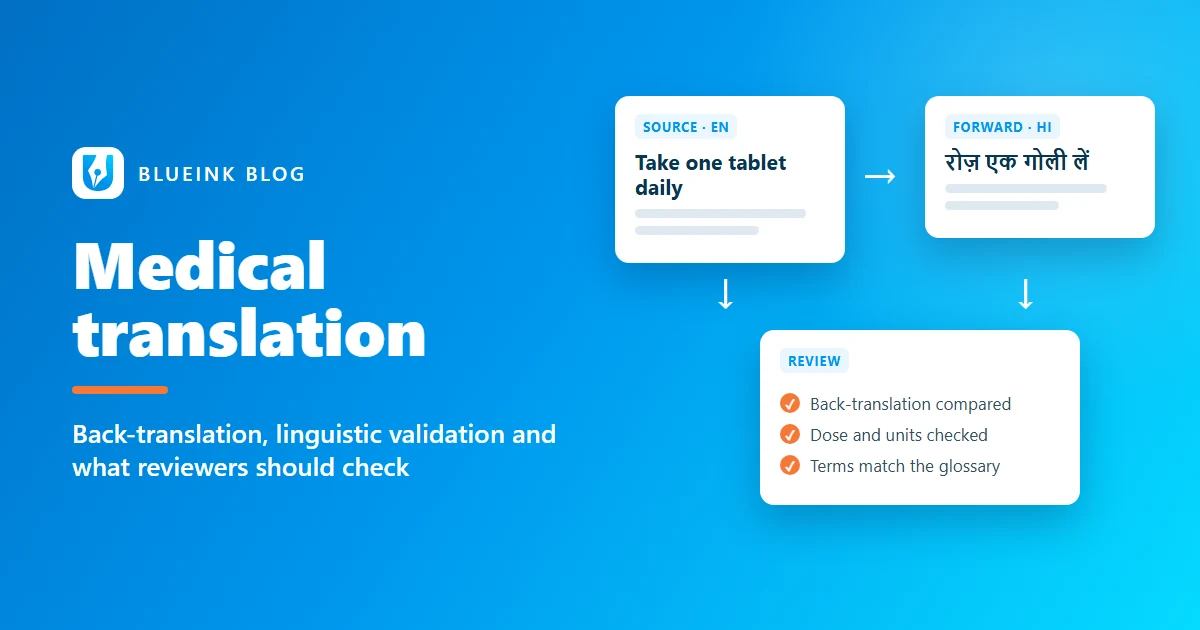
For example, the English instruction "Take one tablet daily" might become "रोज़ एक गोली लें" in Hindi. A back-translation reading "Take one pill every day" confirms that the dose and frequency survived. One reading "Take one pill" would show that "daily" had been lost.
Back-translation has limits. It cannot show whether the translation sounds natural or whether patients understand it.
What is linguistic validation?
Linguistic validation is a multi-step process that checks a translated patient questionnaire is accurate and understood by patients. It is used mainly for patient-reported outcome (PRO) measures. A key reference is the 2005 task force report by Wild et al. from ISPOR (then the International Society for Pharmacoeconomics and Outcomes Research). It sets out ten steps. A 2015 article in the Japanese Journal of Behavior Therapy lists the same ten.
The core is at least two independent forward translations, merged into one version, then back-translated and reviewed. Harmonization then aligns the language versions. Cognitive debriefing then tests the text with "a group of 5 to 8 respondents in the target country" who represent the target population. Their feedback is reviewed, and the text is finalised, proofread and documented in a final report. Before any of this, obtain the developer's permission to translate the instrument. Acquadro and colleagues (2014) call this "one crucial step" that should always come first.
When do you need back-translation or full linguistic validation?
Match the method to the risk and to what the document must prove. The ISPOR report was written for PRO measures, so full linguistic validation fits there. For other content, forward translation with independent review is a common baseline. Add back-translation when a sponsor or ethics committee asks for it, or when a single error could cause harm.
The table below is a practical starting point, not a legal requirement. Confirm the method with your sponsor, your ethics committee or the instrument's developer before work starts.
| Content | Suggested method | Why |
|---|---|---|
| Patient-reported outcome questionnaires | Full linguistic validation, following the ten ISPOR steps | Scores must mean the same thing in every language |
| Informed consent forms and patient information sheets | Forward translation, independent review and a lay-readability check; back-translation if requested | Participants must understand what they agree to |
| Labels and instructions for use | Translation, review against the approved source, unit and symbol checks, then a layout check | An error can lead to misuse of a device |
| Protocols and case report forms | Document translation by a medical specialist, then independent review | Readers are professionals, so terminology must be exact |
| Patient-facing marketing | Transcreation with medical and legal review | Claims must stay within approved wording |
What should reviewers check in a medical translation?
Start with meaning and numbers, then work outward to language and layout. A useful order:
- Meaning: nothing is added, omitted or distorted against the source.
- Numbers and units: dose values, frequencies, dates and units match the source exactly.
- Terminology: terms match the approved glossary and earlier translations.
- Readability: patient text uses plain words that a lay reader understands.
- Source version: the translation matches the current approved source.
- Locale conventions: decimal separators and date formats are localized for the target country. In German, 0.5 mg is written 0,5 mg.
- Symbols and layout: device symbols follow ISO 15223-1, and linguistic testing confirms nothing is cut off in the final layout.
Then grade each error by severity. An MQM critical error "renders the entire content unfit for purpose or poses the risk for serious physical, financial, or reputational harm". In medical content, a wrong dose or unit belongs in that category. Our guide to MQM (Multidimensional Quality Metrics) explains the scoring model.
Where does machine translation fit in medical translation?
Machine translation can produce a first draft, but a qualified linguist must own the final text. ISO 17100:2015, the translation services standard, says "the use of raw output from machine translation plus post-editing is outside the scope" of the standard. A separate standard, ISO 18587:2017, covers full human post-editing of machine output.
For consent forms, questionnaires and labels, we recommend human translation from the start. If machine translation is used for lower-risk reference text, a medical linguist should post-edit it and a second person should review it. Record which method produced each text, so the final report and the trial file show how it was made. That record also helps when an auditor or ethics committee asks how a translation was checked.
Frequently asked questions
Is back-translation a legal requirement?
The regulatory passages quoted in this guide do not name it. Those rules ask for clear, understandable information in the right language. Sponsors, ethics committees and instrument developers may still ask for back-translation, so check their expectations. A questionnaire's developer may also set its own method. If an authority asks for a certified translation, that is a separate requirement, covered in our guide to certified translation in India. Agree the full method in writing at the start, and keep that record in the project file.
Who should do the back-translation?
An independent professional translator who is a native speaker of the source language. The ISPOR task force adds that back translators should have no prior knowledge of the measure. They should not see the source text before or during the work. The person who made the forward translation should not back-translate their own work, because they already know what it is meant to say. A project manager or reviewer then compares the back-translation with the original and agrees any changes with the translators.
Does a good back-translation prove the translation is correct?
No. A clean back-translation shows that the meaning survived the round trip, which is useful evidence. It does not show that the target text reads naturally, suits the culture or is understood by patients. A literal, awkward translation can still back-translate perfectly. Linguistic validation therefore adds cognitive debriefing with patients, and a native reviewer should still read the final text for fluency. Use back-translation alongside these checks, not instead of them. Together they show that the meaning is the same and that patients understand it.
What should you do next?
Decide what each document must prove before you choose a method. List your documents by risk, from questionnaires and consent forms to reference material. Agree the method for each with your sponsor or ethics committee. Ask the instrument's developer for permission early, and build a glossary before translation starts.
We provide back-translation and the linguistic steps of linguistic validation. These are two independent forward translations, reconciliation, back-translation, back-translation review, proofreading and a final report documenting the translation decisions. The full ISPOR-style process adds cognitive debriefing, in which the text is tested with patients in the target country.
Blueink provides medical translation for healthcare and life-science content in all major Indian and global languages. Get an instant quote at blueinki.com.
This is general information, not legal or regulatory advice. Check current requirements with your sponsor, ethics committee or regulator.
Sources
- ICH, E6(R3) Guideline for Good Clinical Practice, final version, 6 January 2025
- EUR-Lex, Regulation (EU) No 536/2014 on clinical trials on medicinal products for human use
- EUR-Lex, Regulation (EU) 2017/745 on medical devices
- CDSCO, New Drugs and Clinical Trials Rules, 2019
- Wild D, et al., Principles of Good Practice for the Translation and Cultural Adaptation Process for Patient-Reported Outcomes (PRO) Measures: Report of the ISPOR Task Force for Translation and Cultural Adaptation, Value in Health 8(2), 2005 (ISPOR summary page)
- Japanese Journal of Behavior Therapy 41(2), Improving the Methodological Quality of the Translation and Cultural Adaptation Process for Patient-Reported Outcome Measures, 2015
- Acquadro C, Bayles A, Juniper E, Translating patient-reported outcome measures: a multi-step process is essential, Jornal Brasileiro de Pneumologia 40(3), 2014
- ISO, ISO 17100:2015 Translation services (iso.org catalogue entry, checked 10 November 2026)
- ISO, ISO 18587:2017 Post-editing of machine translation output (iso.org catalogue entry, checked 10 November 2026)
- ISO, ISO 15223-1:2021 Medical devices: symbols to be used with information to be supplied by the manufacturer (iso.org catalogue entry, checked 10 November 2026)
- MQM Council, MQM error typology and severity levels and scoring
Need help with healthcare translation?
Tell us about your project and we will send a free, no-obligation quote.
More from the blog
What Is MQM? A Plain-English Guide to Measuring Translation Quality
"Good translation" is an opinion. MQM turns it into a measurable score you can track and improve.
What is Translation API and why many companies are using it?
In today’s global economy, businesses are constantly interacting with clients and customers from different regions, cultures, and languages.
Mastering the Art of Marketing Content Translation
When it comes to translating content, there are different approaches for different types of content.